

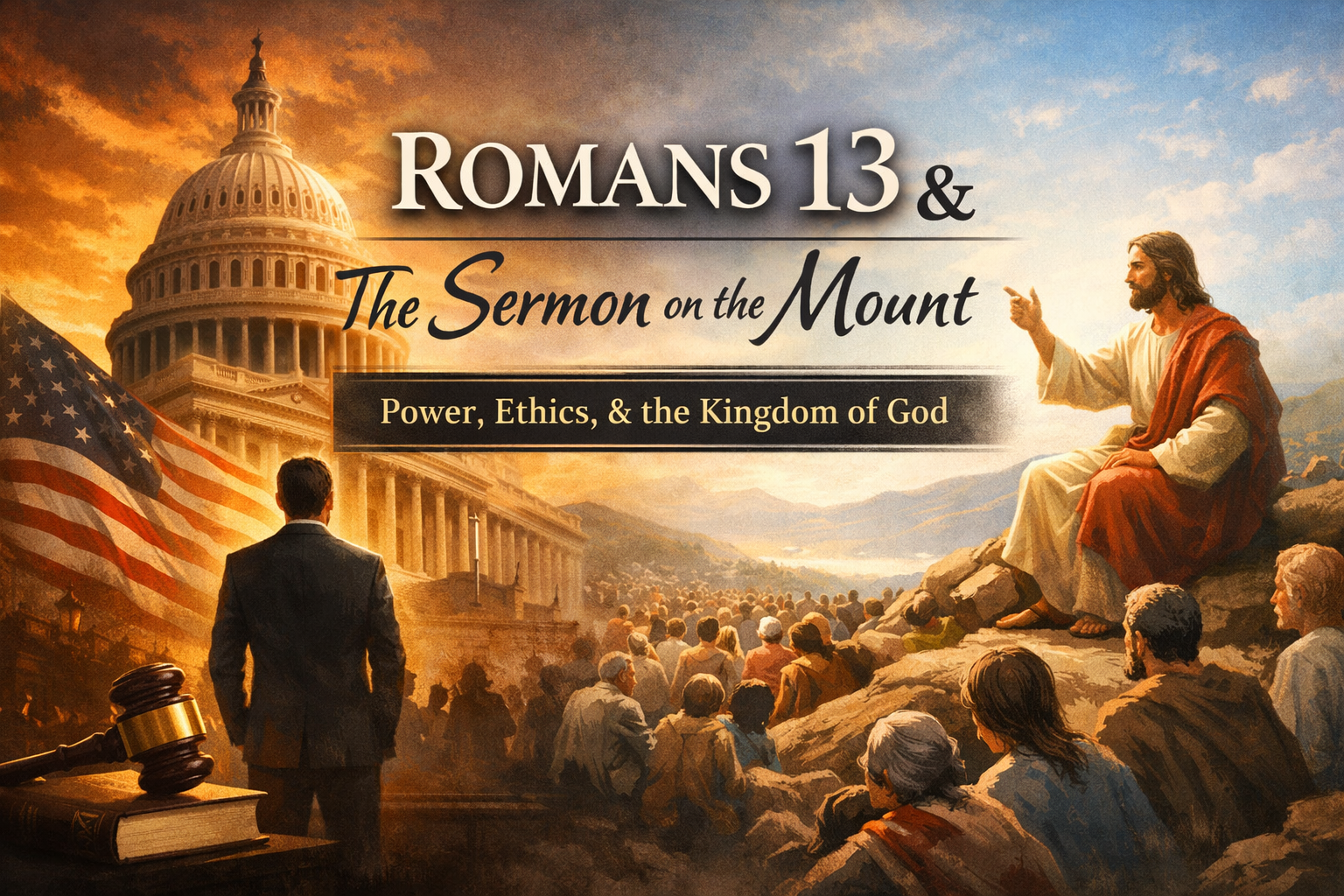
There is a growing argument in some Christian circles that goes something like this:
- The Sermon on the Mount applies to individuals.
- Romans 13 applies to governments.
- Therefore, governments are not bound to operate by the same ethic Jesus gave His followers.
At first glance, that sounds neat and orderly.
But when we slow down and examine it carefully, something doesn’t sit right.
Because governments are not mystical entities floating in the sky.
Governments are made of people.
And people do not stop being disciples when they gain power.
What Romans 13 Actually Says
In Romans 13:1–7, Paul writes that governing authorities are established by God and that believers should submit to them. He describes rulers as “God’s servant for your good” and says they bear the sword to restrain wrongdoing.
Notice what Paul does not say.
He does not say:
- Governments are morally exempt.
- Leaders are immune from Christ’s commands.
- Authority overrides discipleship.
Romans 13 describes the purpose of government — to promote good and restrain evil.
It does not create a spiritual loophole.
If a ruler ceases to do good and instead oppresses, exploits, or acts unjustly, Scripture consistently shows that God holds that ruler accountable. Pharaoh was judged. Nebuchadnezzar was humbled. Herod was struck down. Power has never equaled immunity before God.
What the Sermon on the Mount Demands
In Matthew 5–7, Jesus teaches:
- Blessed are the meek.
- Blessed are the merciful.
- Love your enemies.
- Turn the other cheek.
- Do unto others as you would have them do unto you.
- Seek first the Kingdom of God.
These are not suggestions for private spirituality.
These are Kingdom ethics.
Now here is the tension:
If individuals must live this way…
And governments are made up of individuals…
At what point does gaining office cancel Christ’s commands?
It doesn’t.
There is no verse where Jesus says,
“Follow Me… unless you’re in government.”
In fact, Scripture holds leaders to a higher standard:
- “To whom much is given, much is required.” (Luke 12:48)
- Teachers will be judged more strictly. (James 3:1)
- God repeatedly condemns rulers who neglect the poor and vulnerable.
Power increases responsibility. It does not decrease it.
The Myth of Dual Ethics
Some argue there are two moral systems:
- One for private Christians.
- One for public officials.
But Jesus never taught dual ethics.
When Peter used the sword, Jesus told him to put it away.
When James and John wanted to call down fire from heaven, Jesus rebuked them.
When asked about Caesar, Jesus said, “Render to Caesar what is Caesar’s, and to God what is God’s.”
That statement sets limits. Caesar has authority — but not ultimate authority. God does.
If a Christian enters government, they do not leave the Kingdom behind at the door.
What About Forcing “Christian” Laws?
This is where the conversation becomes uncomfortable.
Jesus never advanced His Kingdom by coercion.
He healed.
He taught.
He forgave.
He called people to repentance.
He invited — He did not force.
Faith cannot be compelled by law.
The moment Christianity depends on state power to produce spiritual conformity, it risks confusing the Kingdom of God with the kingdoms of this world.
That does not mean Christians should withdraw from politics. It means they must never forget which Kingdom they ultimately serve.
Jesus said, “My Kingdom is not of this world.”
If that is true, then the Church must be cautious about equating national power with divine mission.
The Test: The Least of These
In Matthew 25, Jesus identifies Himself with:
- The hungry
- The stranger
- The sick
- The prisoner
Throughout Scripture, rulers are judged by how they treat:
- The poor
- The widow
- The orphan
- The foreigner
If ordinary believers are responsible for mercy…
How much more those who wield authority?
A government that claims Christian identity but neglects the vulnerable should not hide behind Romans 13. That passage calls rulers “God’s servant for your good.” The good of whom? All people — especially the powerless.
The Real Question
This isn’t about party lines.
It isn’t about conservative versus progressive.
It is about consistency.
If Christ commands humility, mercy, enemy-love, and care for the least — does gaining political power free a Christian from those commands?
Or bind them to them even more?
Romans 13 establishes order.
The Sermon on the Mount establishes character.
The two are not enemies.
But neither does Romans 13 cancel the ethic of Jesus.
Final Thought
Christian leaders in government are still Christians.
They are still disciples.
They are still accountable to the teachings of Christ.
And if anything, because they hold power, they are called to reflect Him more — not less.
The Kingdom of God is not advanced by domination.
It is revealed through righteousness, justice, humility, and mercy.
That applies to the private citizen.
And it applies to the person holding office.
The question is not whether Christians should influence government.
The question is whether government power is shaping Christians — or whether Christ is shaping those in power.
That is where the real test lies.
Leave a Reply