

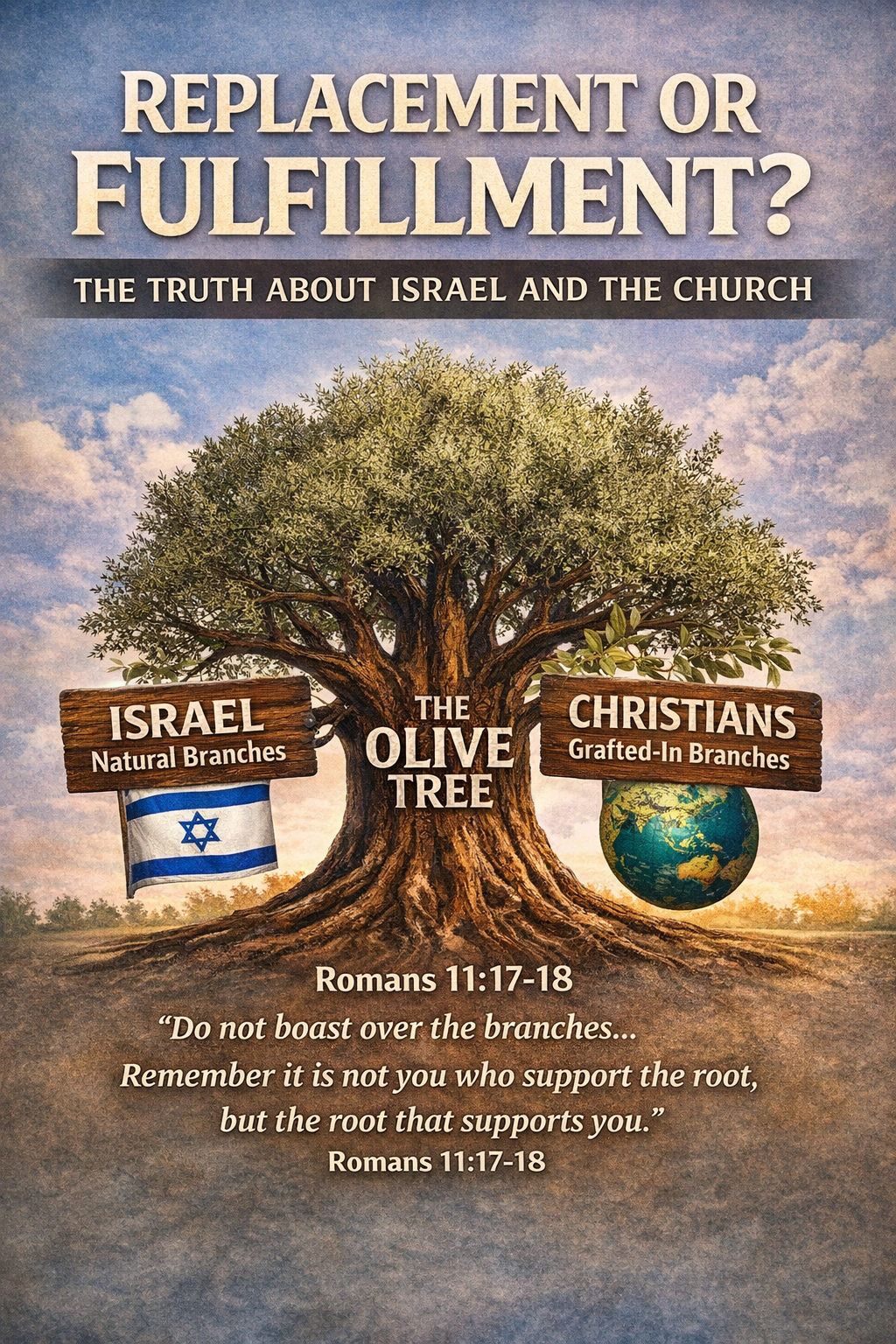
There’s a question that quietly sits underneath a lot of modern Christian conversations, even if it’s not always said out loud: did the Church replace Israel, or is something deeper going on in the story God has been telling from the beginning? It’s one of those topics where strong opinions form quickly, but when you slow down and actually read the full flow of Scripture—especially Romans 9 through 11—you start to see that the answer isn’t as simple as replacement. It’s not about one group being swapped out for another. It’s about a plan that was always bigger than we tend to make it.
Paul, writing in Romans, doesn’t avoid the tension. In fact, he leans directly into it. He begins by acknowledging something difficult: many in Israel had not accepted Jesus as the Messiah. That reality could easily lead someone to assume that God had moved on, that His promises had shifted entirely to a new people. But Paul stops that line of thinking immediately with a direct question and an even more direct answer: “Has God rejected His people? By no means.” That statement alone should make us pause before we jump to conclusions. If Paul—himself a Jew, deeply rooted in the history and promises of Israel—says God has not rejected His people, then any theology that assumes total replacement needs to be reexamined carefully.
What Paul does next is where things start to come into focus. He reframes what it has always meant to belong to God. He explains that not everyone who is descended from Israel is truly part of Israel in the spiritual sense. That might sound surprising at first, but it’s consistent with how God has always worked. Even in the Old Testament, the line of promise was never simply about physical descent. It was about God’s calling, God’s promise, and ultimately, faith. This is where many people begin to see the shift and assume that Israel has been set aside entirely, but Paul doesn’t go there. Instead, he builds toward something more layered, something that holds both truths at the same time.
He introduces the image of an olive tree, and it’s one of the most important illustrations in the New Testament for understanding this topic. The tree itself represents the people of God, rooted in the promises made long ago. The natural branches represent Israel. Some of those branches, Paul says, were broken off—not because they were Israel, but because of unbelief. Then he describes something unexpected: wild branches, representing Gentiles, being grafted into that same tree. Not a new tree. Not a replacement tree. The same one. That detail matters more than most people realize.
Because if Gentiles are being grafted in, then they are not replacing the root—they are joining it. They are being brought into something that already existed, something that was established through God’s covenant with Israel. That’s why Paul gives a warning that still feels incredibly relevant today. He tells Gentile believers not to become arrogant, not to boast over the natural branches. His reasoning is simple but powerful: the root supports you, not the other way around. In other words, the story didn’t start with us, and it doesn’t revolve around us replacing anyone. It’s a story we’ve been invited into.
What makes this even more interesting is that Paul doesn’t present Israel’s current state as final. He describes it as a kind of partial hardening, something temporary, not permanent. He says it lasts until the fullness of the Gentiles comes in, which suggests that what we’re seeing is part of a larger unfolding plan. Then he says something that has been discussed and debated for generations: “all Israel will be saved.” However someone interprets the details of that statement, the direction is clear. God is not finished. The door is not closed. The promise is not canceled.
And that idea carries weight when you start looking at the broader biblical narrative. God’s covenant with Israel wasn’t described as something fragile or easily revoked. Throughout the Old Testament, God ties His promises to the very order of creation, using language that emphasizes permanence and faithfulness. When Paul later says that the gifts and calling of God are irrevocable, he’s reinforcing that same theme. God does not abandon His promises, even when people struggle, even when there is rejection, even when the story takes unexpected turns.
When you carry that understanding into the New Testament as a whole, you begin to see that Jesus didn’t come to erase Israel’s story. He came to fulfill it. He embodies everything Israel was called to be, and through Him, the door opens to the nations. This is where the idea of replacement starts to fall apart, because what you actually see is expansion. The promise given to Abraham—that through him all nations would be blessed—comes into full view. Not by discarding Israel, but by extending the invitation outward through Christ.
Even in the book of Revelation, there are moments that echo this continuity rather than a break. References to the tribes of Israel and the imagery tied to them suggest that God’s connection to Israel remains part of the unfolding story. For many, this aligns with Paul’s words about a future recognition of Jesus as Messiah among Israel, reinforcing the idea that what we are seeing now is not the end of the story, but a chapter within it.
All of this brings us back to the central point that often gets lost in the debate. The focus of Scripture is not on one group replacing another. It’s not about elevating one identity while dismissing another. The focus is on Christ. He is the one through whom both Jews and Gentiles come together. He is the one who fulfills the promise, who opens the way, who unites what was divided. When Paul talks about breaking down the wall between Jew and Gentile, he’s not describing a takeover. He’s describing reconciliation.
And maybe that’s the part worth sitting with the longest. Because it challenges something in us. It challenges the tendency to draw lines, to claim ownership, to simplify a story that was never meant to be reduced to “us versus them.” Instead, it calls us back to humility. To remember that if we are part of God’s people, it is not because we replaced anyone, but because we were shown mercy and brought in.
That perspective changes how you read the Bible. It changes how you view Israel. It changes how you understand your own place in the story. And it brings you back to a truth that runs from Genesis to Revelation: God keeps His promises, and His plan has always been bigger than we imagine.
If you keep following that thread all the way through Scripture, it becomes harder and harder to see this as a story of replacement, and easier to recognize it as a story of fulfillment that unfolds in layers. By the time you get to the words of Jesus Himself, the focus sharpens even more. He doesn’t point people back to identity markers or lineage as the defining proof of belonging to God. He consistently points to something deeper—something internal, something rooted in truth and response to Him.
There’s a moment in John’s Gospel where Jesus is speaking to people who were confident in their connection to Abraham. Their identity felt secure because of their heritage. But Jesus challenges that assumption in a way that must have been shocking at the time. He tells them that if they were truly Abraham’s children, they would do what Abraham did. In other words, it wasn’t enough to trace their lineage back through history. The real evidence was whether they shared the same kind of faith that Abraham had—the kind of faith that trusted God, even when it didn’t make sense. That statement alone reframes everything. It moves the conversation away from biology and into belief, away from ancestry and into alignment with God’s truth.
But even there, Jesus isn’t dismissing Israel. He isn’t cutting them off from the story. He’s calling them back to what the story was always meant to produce. The same pattern shows up again when John the Baptist warns that God can raise up children for Abraham from stones if He chooses. It’s a reminder that God’s promise isn’t limited by human assumptions, but it’s also not disconnected from His original covenant. Instead, it reveals that the covenant was always pointing toward something greater—toward a people defined by faith.
This is where the tension and the beauty of the story meet. Because on one hand, the New Testament is clear that salvation is found in Christ alone, and that this invitation extends to all people, regardless of background. On the other hand, it never presents that expansion as a cancellation of what came before. It presents it as the natural progression of what God had already set in motion. The promise to Abraham was never meant to stay within one group. It was always meant to reach the nations. What we see in the Church isn’t a replacement of Israel—it’s the fulfillment of that promise extending outward, just as God said it would.
And when you bring Revelation into the picture, that continuity becomes even more intriguing. The imagery is rich, symbolic, and sometimes difficult to interpret, but certain themes stand out clearly. There are references to the tribes of Israel, to sealed servants, to a people who come through great tribulation. For many readers, this points to a future moment where there is a widespread recognition of Jesus as Messiah among the people of Israel. Whether someone interprets every detail literally or symbolically, the presence of Israel in the narrative is hard to ignore. It doesn’t read like a story where they’ve been erased. It reads like a story where they are still part of the unfolding plan.
This lines up closely with what Paul described when he spoke of a partial hardening and a future turning. It suggests that what we’re seeing now is not the final picture, but a phase within a larger timeline that God fully understands, even if we don’t. And that idea should produce humility more than certainty. Because if Paul himself steps back at the end of his explanation and essentially says, “God’s wisdom is beyond fully tracing out,” then it’s probably wise for us to hold our conclusions with care.
At the same time, there is something incredibly grounding about seeing how consistent God is throughout all of this. The same God who made a covenant with Abraham is the same God who sent Christ. The same God who worked through Israel is the same God who opened the door to the Gentiles. There isn’t a shift in character or intention. There’s a continuation, a fulfillment, a widening of the scope that was always there from the beginning.
And that brings the focus back to something that can get lost when conversations become too centered on identity or prophecy charts or timelines. The center of all of this is still Jesus. He is the one who defines what it means to belong to God. He is the one who fulfills the law, the prophets, and the promises. He is the one who breaks down divisions and creates one people out of many. When Paul speaks about Jews and Gentiles being brought together, he doesn’t describe two separate paths. He describes one new humanity formed in Christ.
That truth carries weight for how we live, not just how we interpret theology. Because if we’ve been grafted in, then our posture shouldn’t be one of superiority, but of gratitude. It should shape how we speak about Israel, how we understand God’s promises, and how we view our own place in the story. We are not the root. We are part of what God has chosen to grow from it.
It also challenges the way we think about faith itself. If belonging to God has always been about faith—if that was true for Abraham, true in Paul’s time, and true now—then the dividing line has never been as simple as heritage or labels. It has always come down to whether someone trusts God and responds to Him. That’s what unites people across time, across cultures, across backgrounds. That’s what forms the people of God.
So when people ask whether Christians replaced Israel, the more complete answer seems to be that the story doesn’t support that kind of framing. It’s not a story of replacement. It’s a story of invitation, expansion, and fulfillment. It’s a story where God remains faithful to His promises, even as He brings more people into them. It’s a story where Israel is not discarded, but remains part of a plan that continues to unfold. And it’s a story where, in the end, everything centers on Christ—the one through whom all of it makes sense.
And maybe the most honest place to land is the same place Paul did: recognizing that while we can see the outline, we don’t see every detail. But what we do see is enough to trust the character of God, enough to reject arrogance, and enough to hold onto the truth that His promises—every one of them—still stand.