

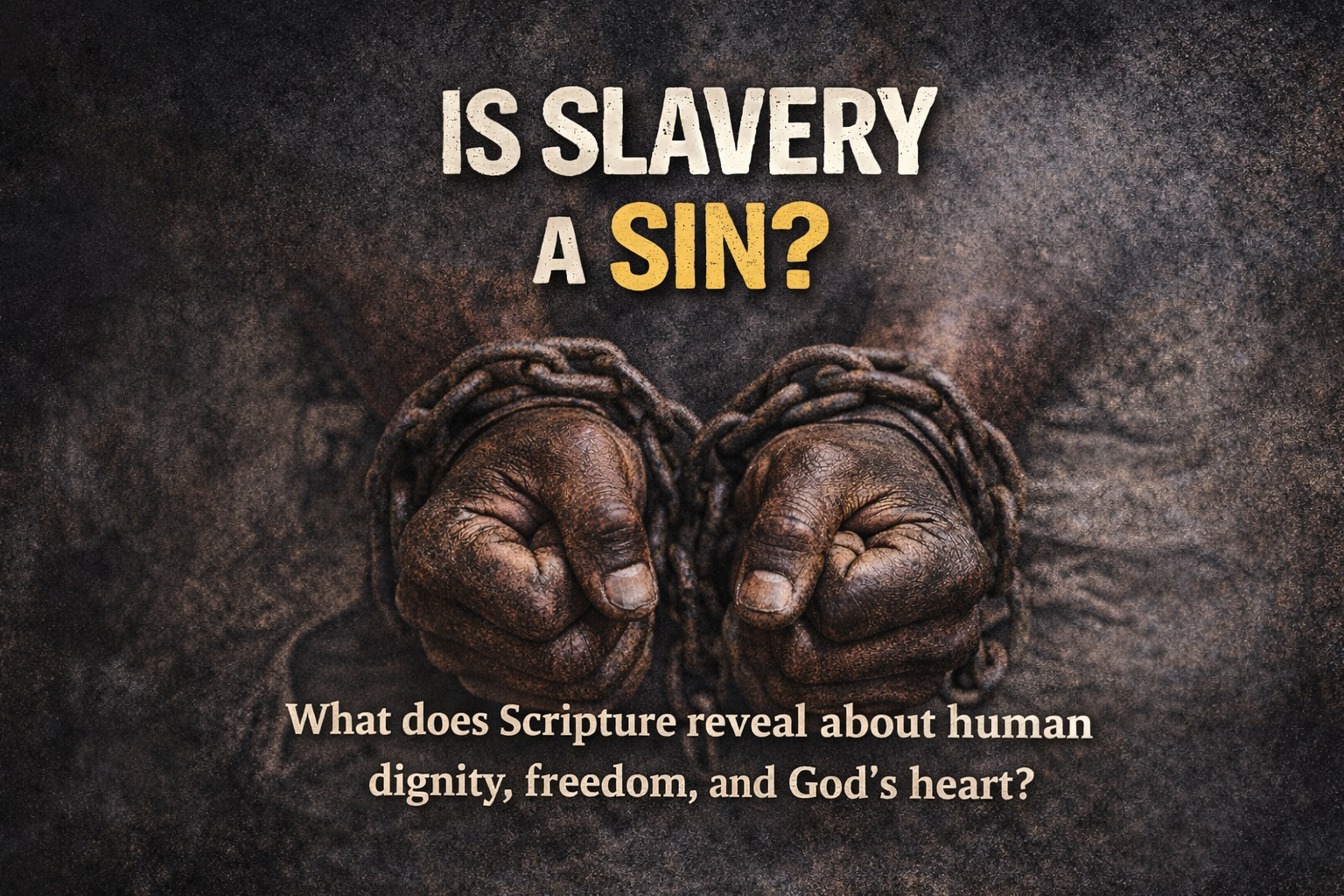
It’s a question that seems like it should have an obvious answer, yet somehow continues to be debated in certain circles, often framed around whether Scripture explicitly labels it as such. For some, the argument begins and ends there: if the Bible doesn’t directly say, “slavery is a sin,” then perhaps it isn’t. But that way of approaching Scripture misses something deeper about how truth is revealed. Not everything in the Bible is handed to us as a one-line definition. Much of it requires discernment—an understanding that comes from reading the full narrative of God’s character, His actions, and His commands.
We already accept this in other areas of theology without hesitation. The word “rapture” doesn’t appear in the Bible, yet many believe in the concept because passages like 1 Thessalonians 4:17 describe believers being “caught up” together. In the same way, Jesus never says the exact sentence, “I am God,” yet in John 8:58 He declares, “Before Abraham was, I AM,” echoing the divine name revealed in Exodus. These truths are not built on isolated phrases, but on the full weight of Scripture taken together. We don’t dismiss them simply because they aren’t spelled out in a single line—we discern them.
So when it comes to slavery, the question isn’t just whether a specific phrase exists. The question is: what does the whole of Scripture reveal about God’s heart toward human beings, dignity, freedom, and the treatment of others?
From the beginning, the Bible presents human beings as created in the image of God. That alone establishes a foundation of inherent worth that cannot be owned, traded, or reduced to property without violating something sacred. This idea doesn’t need an additional command to explain why it matters. If every person bears God’s image, then to treat a person as an object is already a distortion of that truth.
And yet, as we move through Scripture, we see that human societies did practice forms of servitude and slavery. That reality is often pointed to as justification, but it’s important to understand what’s actually happening in those texts. The Bible frequently describes human behavior without endorsing it. There are many things recorded in Scripture that are not presented as moral ideals, but as reflections of a fallen world. The presence of something in the text does not automatically mean approval of it.
What we do see consistently, however, is God moving in the direction of freedom and restoration. In Exodus, God hears the cries of an enslaved people and responds—not with indifference, but with deliverance. He doesn’t affirm their condition; He rescues them from it. That moment becomes one of the defining revelations of who God is: a God who sees oppression and acts against it.
That pattern continues. The prophets speak against injustice, exploitation, and the mistreatment of the vulnerable. They don’t frame oppression as morally neutral. They confront it. By the time we reach the teachings of Jesus, the direction becomes even clearer. He announces His mission in Luke 4:18 by declaring that He has come “to proclaim freedom for the captives.” He centers His message on love—love of neighbor, love of the outsider, love expressed through action, not just belief.
And then He gives a standard so simple that it cuts through every attempt to complicate it: “Do to others as you would have them do to you.”
That statement alone forces a level of honesty that no historical argument can avoid. Because once you apply it personally, the conversation changes. It’s no longer theoretical. It becomes real. Would you accept being owned? Would you accept your family being treated as property, your freedom taken, your autonomy stripped away? If the answer is no—and for most people, it is—then the moral clarity begins to surface.
At that point, the debate often shifts to context. People will say that slavery existed across many cultures, that it was part of the ancient world, that even societies we consider advanced participated in it. All of that may be historically accurate, but it doesn’t answer the moral question. Widespread practice has never been a reliable measure of righteousness. History is filled with things that were common and deeply wrong at the same time.
The deeper issue is not whether slavery was normal—it’s whether it aligns with the character of God and the teachings that flow from Him.
And when you begin to measure it against those standards—against love, against justice, against the value of human life—it becomes increasingly difficult to justify.
This is where some will point to the New Testament and raise what they believe is a stronger challenge. They’ll reference passages where instructions are given to servants or slaves, where obedience is encouraged, and argue that this suggests acceptance, or at least neutrality, toward the institution itself. On the surface, those verses can seem difficult, especially when read in isolation. But once again, context and the broader message of Scripture matter.
The New Testament was written into a world where slavery was already deeply embedded in the social and economic structure. It wasn’t a marginal practice—it was a dominant system that shaped everyday life across the Roman Empire. The early church did not have political power, military influence, or the ability to dismantle societal institutions overnight. What it did have was something far more subversive: a message that redefined identity, authority, and value at a foundational level.
When Paul writes to believers within that system, he is not endorsing slavery as a moral good. He is speaking to people living within a reality they could not immediately escape, giving them guidance on how to live in a way that reflects Christ in the middle of it. But even within those instructions, something radical is happening.
In letters like Galatians 3:28, Paul declares that in Christ “there is neither slave nor free… for you are all one.” That statement doesn’t just offer spiritual comfort—it dismantles the very hierarchy that slavery depends on. It levels the ground between people who, in society, were seen as fundamentally unequal. It introduces a truth that, if fully lived out, cannot coexist with the idea that one person can own another.
In the letter to Philemon, we see this even more personally. Paul appeals on behalf of Onesimus, a runaway slave, urging Philemon to receive him “no longer as a slave, but better than a slave, as a dear brother.” That language matters. Paul doesn’t command a political revolution, but he plants something deeper—a relational transformation that challenges the very foundation of ownership and status. He reframes Onesimus not as property, but as family.
And that’s the pattern we see throughout the New Testament. The gospel doesn’t always confront systems through immediate external force—it transforms hearts, identities, and relationships in ways that eventually make those systems unsustainable. It calls masters to treat those under them with justice and fairness, reminding them that they too have a Master in heaven. It calls believers to see one another not through social categories, but through shared humanity and shared belonging in Christ.
When you step back and look at the full picture, the trajectory becomes clear. Scripture moves consistently toward freedom, dignity, and equality—not toward the preservation of systems that strip those things away.
This is why relying on the absence of a direct phrase like “slavery is a sin” becomes such a fragile argument. Because the Bible does something more powerful than simply labeling individual actions—it reveals the heart of God. And once you understand that heart, certain conclusions follow naturally.
A God who creates all people in His image does not affirm their dehumanization.
A God who hears the cries of the oppressed does not justify their oppression.
A Savior who came to set captives free does not endorse captivity as a moral good.
At some point, the question stops being about technical wording and becomes a matter of honesty. Not just intellectual honesty, but moral and spiritual honesty. Because deep down, most people don’t struggle to recognize injustice when they imagine themselves on the receiving end of it.
That’s why Jesus’ teaching remains so powerful. “Do to others as you would have them do to you” isn’t just a guideline—it’s a mirror. It removes the distance that allows us to rationalize harmful systems. It forces us to confront whether we are applying the same standard to others that we instinctively apply to ourselves.
And when you hold slavery up to that standard, it doesn’t hold.
It’s worth acknowledging that throughout history, Scripture has been misused to justify slavery and other forms of oppression. That reality doesn’t weaken the Bible—it exposes how easily people can twist truth when it serves their interests. The same texts that were used to defend slavery were also used, by others, to fight against it. The difference wasn’t in the words themselves, but in how they were read—whether through the lens of power, or through the lens of love, justice, and the full message of Christ.
So is slavery a sin?
You may not find the exact sentence written in those exact words. But when you read Scripture as a whole—when you follow the thread of God’s character, His commands, and His redemptive work—the answer becomes increasingly difficult to deny.
Some truths are not hidden—they are revealed through the consistency of what God values.
And when it comes to human dignity, freedom, and the way we treat one another, Scripture speaks with a clarity that goes far beyond a single line.
The real question is not whether the Bible says enough.
The real question is whether we’re willing to hear what it’s been saying all along.