

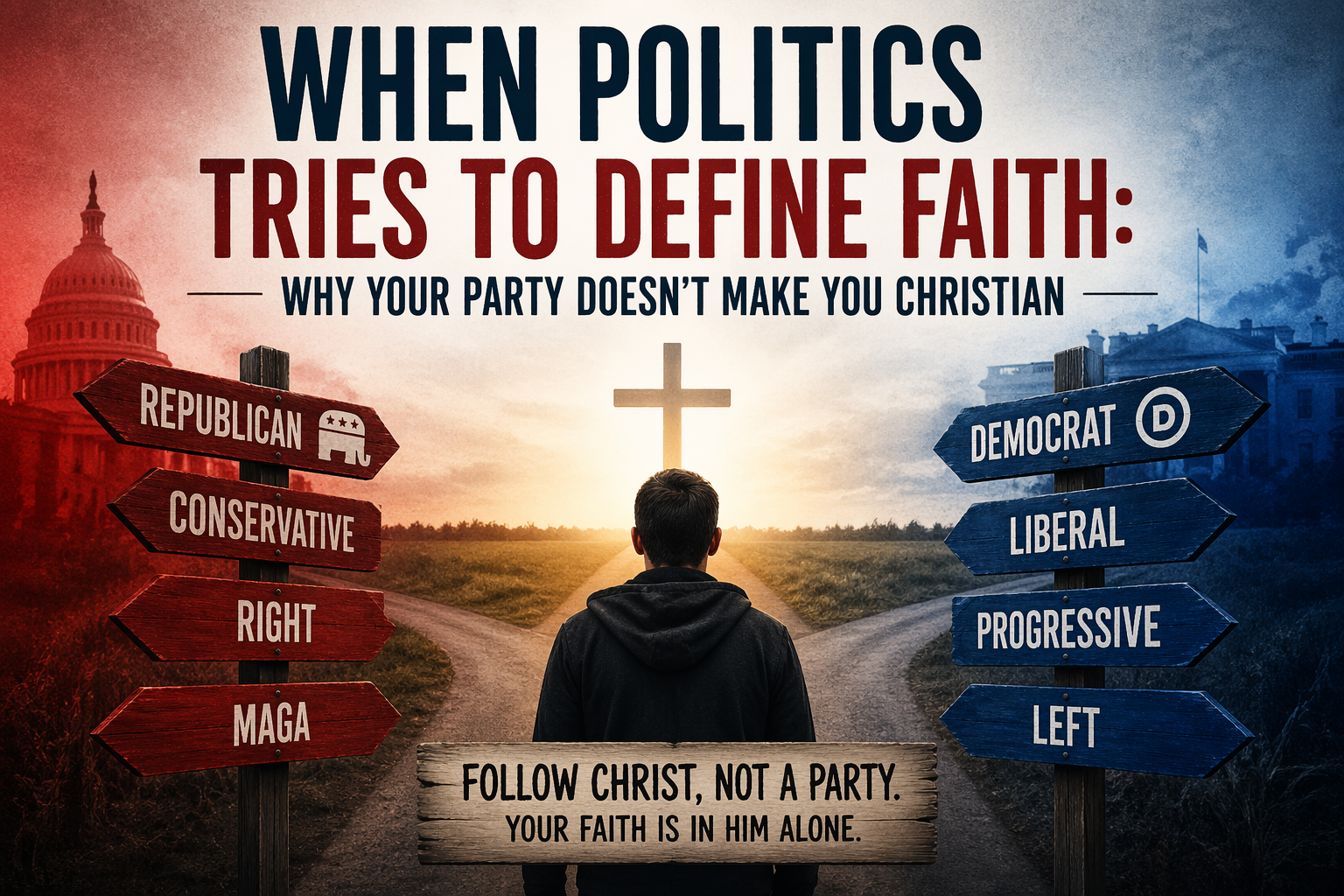
There’s a subtle shift happening right now that not everyone is catching, but it’s shaping how people see faith, truth, and even their identity. You hear it in conversations, in podcasts, in headlines, and across social media—voices confidently telling others that if you don’t vote a certain way, support a certain party, or align with a specific political ideology, then your faith is somehow compromised… or worse, not real at all. It’s no longer just about policy disagreements or differing perspectives—it’s become a question of who is and isn’t a “true” Christian based on political alignment. And that should give us pause.
Because somewhere along the way, lines that were never meant to be connected have been blurred. Republican does not equal Christian. Democrat does not equal Christian. Conservative does not equal Christian. Liberal does not equal Christian. Progressive does not equal Christian. These are political identities—human systems, shaped by culture, history, priorities, and power structures that shift over time. Christianity, on the other hand, is not something shaped by culture. It is rooted in a person—Jesus Christ—and in a truth that does not move with the tides of public opinion.
Jesus never told anyone to follow a party. He never said, “Align yourself with Caesar and you will be made right.” In fact, when people tried to trap Him with political questions, He consistently redirected the focus back to God. “Give to Caesar what is Caesar’s, and to God what is God’s.” That alone should tell us something important—there is a distinction. There always has been. Government has its place, but it was never meant to define our faith or replace our identity in God.
The concern isn’t that Christians engage in politics. People have always wrestled with how to live out their faith in the world around them, and that includes civic responsibility. The issue is when political identity begins to take the place of spiritual identity. When someone starts to believe that their party represents righteousness in full, or that opposing parties represent evil in total, something has already gone off course. No political platform perfectly reflects the heart of God. None of them carry the full weight of truth, justice, mercy, and grace the way Christ does.
And yet, we’re seeing more and more people speak as if they do. Statements like “You can’t be a Christian and vote for them,” or “Real believers would never support that side,” are being said with confidence, sometimes even with conviction. But those statements aren’t grounded in Scripture—they’re rooted in personal interpretation, cultural influence, and often, fear or frustration. They place human systems on a level they were never meant to occupy.
Scripture paints a very different picture of what it means to belong to Christ. It doesn’t start with policies or platforms. It starts with the heart. Faith in Jesus. Belief that He died and rose again. Understanding that His sacrifice was for our sins—not just the sins we agree with calling out, but all of them. It speaks of surrender, of transformation, of learning to walk in His ways, not just claiming His name. When Jesus said, “Follow me,” He wasn’t inviting people into a movement built on political influence—He was calling them into a relationship that would reshape everything about who they are.
And that’s where the real tension begins. Because following Christ doesn’t always fit neatly into a political box. In some areas, it may align with one side. In others, it may challenge it directly. The teachings of Jesus cut deeper than partisan lines—they confront pride, hypocrisy, injustice, lack of mercy, and hardened hearts on all sides. That means no one gets to claim full ownership of Him, and no party gets to define what it means to truly follow Him.
This is why it’s dangerous to let others convince you that your standing with God is tied to your political affiliation. Once that idea takes hold, it shifts your focus away from Christ and onto something else entirely. It becomes less about knowing Him and more about proving yourself within a system that was never designed to save you in the first place.
And if we’re honest, that shift is already happening.
If that shift continues unchecked, it doesn’t just blur the lines—it replaces them. Faith becomes filtered through ideology. Scripture becomes something people selectively use to defend positions rather than something that shapes the heart. And slowly, without even realizing it, people begin to follow something that looks like Christianity on the surface but is rooted in something entirely different underneath.
That’s why it’s important to come back to what Scripture actually says about judgment, identity, and what it means to belong to Christ. The Bible never describes the final judgment as a moment where people are separated based on political affiliation. There’s no mention of party lines, ideologies, or national allegiances determining someone’s standing before God. Instead, it speaks clearly about personal accountability—about our actions, our hearts, and our relationship with Him. Each person stands on their own account, not as a representative of a political system, but as an individual who either knew Christ or did not.
That doesn’t mean our decisions don’t matter. They do. The way we live, the things we support, the choices we make—including how we vote—can reflect what’s in our hearts. There are real moral implications to the positions we take and the causes we stand behind. But that’s very different from saying that a political party, as a whole, determines whether someone is Christian or not. Those are not the same thing, and combining them creates confusion where Scripture brings clarity.
Because at its core, Christianity has never been about external labels—it’s about internal transformation. It’s about believing that Jesus Christ is who He said He is. That He died for our sins and rose again. That through Him, we are offered grace, mercy, and redemption we could never earn on our own. It’s about responding to that truth by following Him—not just in word, but in heart, in action, and in daily life. It’s about knowing Him personally, not just knowing about Him.
Jesus Himself makes this distinction clear when He warns that not everyone who claims His name truly belongs to Him. “I never knew you.” That statement isn’t directed at people who chose the wrong political side—it’s directed at those who lived disconnected from Him, even while appearing outwardly aligned. That should shift our perspective. Because it tells us that the defining line isn’t drawn between political groups—it’s drawn between those who know Christ and those who don’t.
And that’s the line that matters.
When people begin to say that one political identity is the “Christian” identity, they unintentionally create a false standard—one that elevates human systems and lowers the true weight of the gospel. It can lead others to believe that aligning with a party is the same as aligning with Christ, or worse, that rejecting a party is the same as rejecting Him. That kind of thinking doesn’t just misrepresent Christianity—it can push people away from it altogether.
Because what happens when someone sees hypocrisy within that political identity? What happens when the actions, attitudes, or priorities don’t reflect the heart of Jesus? If faith has been tied to that system, then disillusionment with the system can turn into disillusionment with Christ Himself. And that’s a heavy consequence for something that was never meant to be connected in the first place.
This is why discernment matters. Not everything that claims to represent Christianity actually reflects it. Not every voice speaking “in defense of faith” is rooted in truth. Sometimes, it’s influenced more by culture, power, or personal perspective than by Scripture. And if we’re not careful, we can start to accept those messages without questioning whether they align with the words and example of Jesus.
The call, then, is simple—but not always easy. Keep your identity anchored in Christ. Let your understanding of right and wrong come from Scripture, not from party platforms. Engage with the world around you, think critically, vote with conviction—but don’t confuse any of that with what saves you or defines you.
Because in the end, the question won’t be what political side you stood on.
It will be whether you truly followed Him.